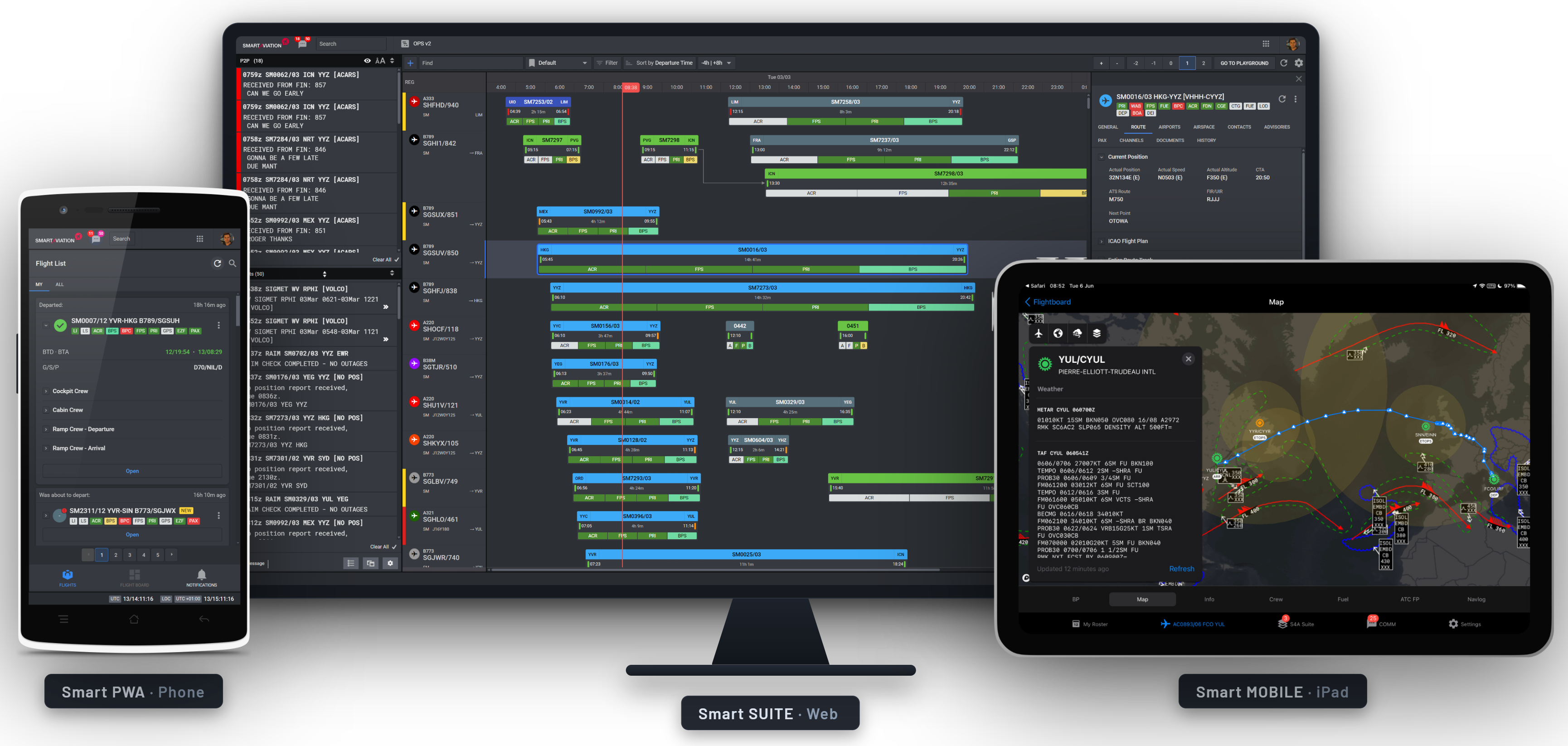
Every airline CFO watches the same two screens with the same unease: the geopolitical news and the jet fuel price chart. The two have never been more tightly coupled. Political instability, sanctions, and supply disruptions send fuel prices swinging in ways no hedging strategy fully absorbs - and conflict-driven airspace closures force reroutes that add hours and tonnes to sectors that used to be routine. For a major carrier, fuel is one of the largest single cost items on the books: an airline generating $18 billion in revenue can easily spend close to $4 billion of it on fuel alone. When the per-tonne price jumps 20%, no commercial initiative on earth recovers that money as fast as it disappears.
Here is the uncomfortable truth and the genuine opportunity in one sentence: an airline cannot control the price of fuel, but it has far more control over the quantity it burns than most operations currently exercise. Across Smart4Aviation's suite, fuel efficiency isn't a module - it's a property of how the whole operation runs. Let's follow the kilograms.
Smart LOAD (Weight & Balance and Load Planning): Finding savings in the balance
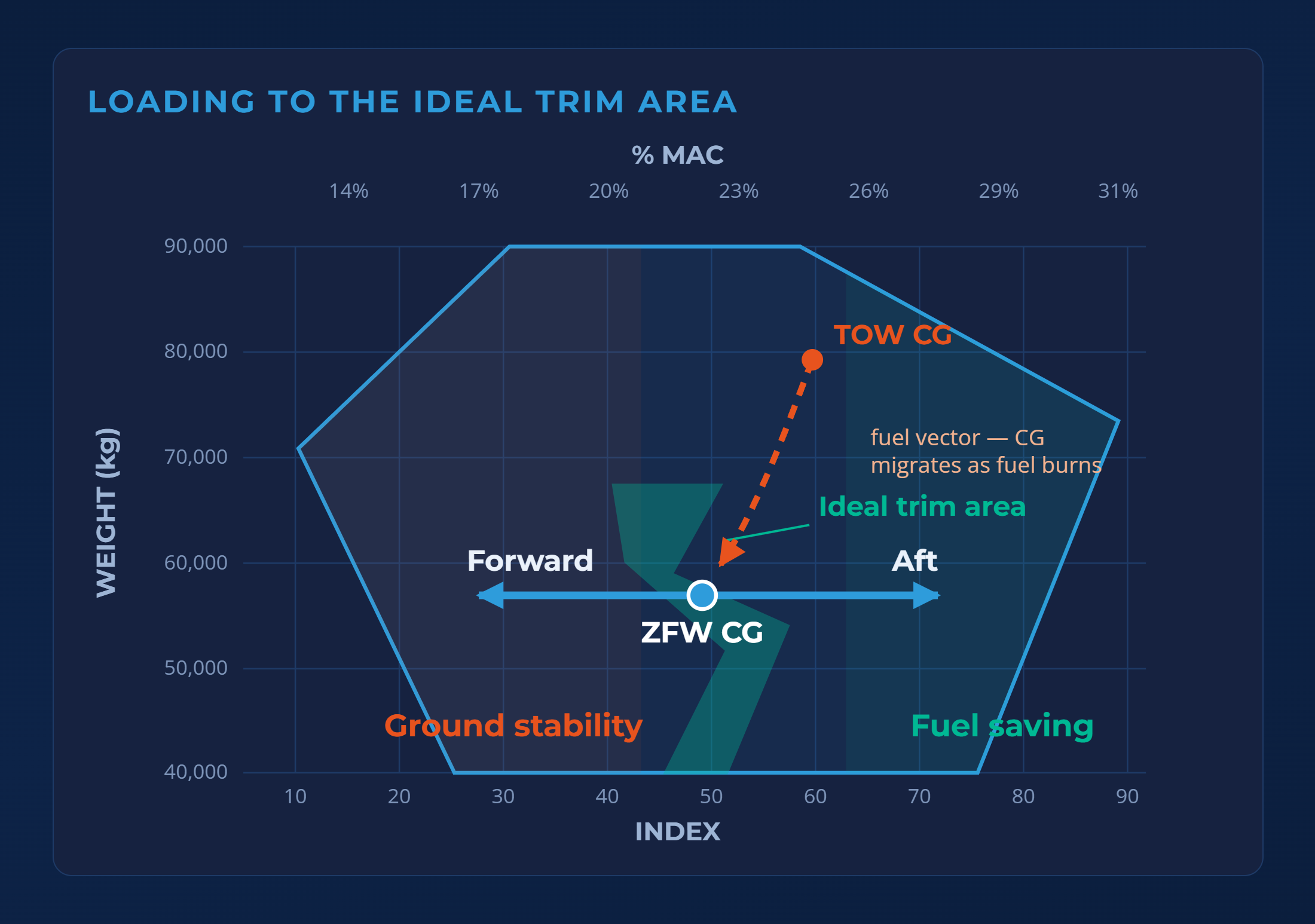
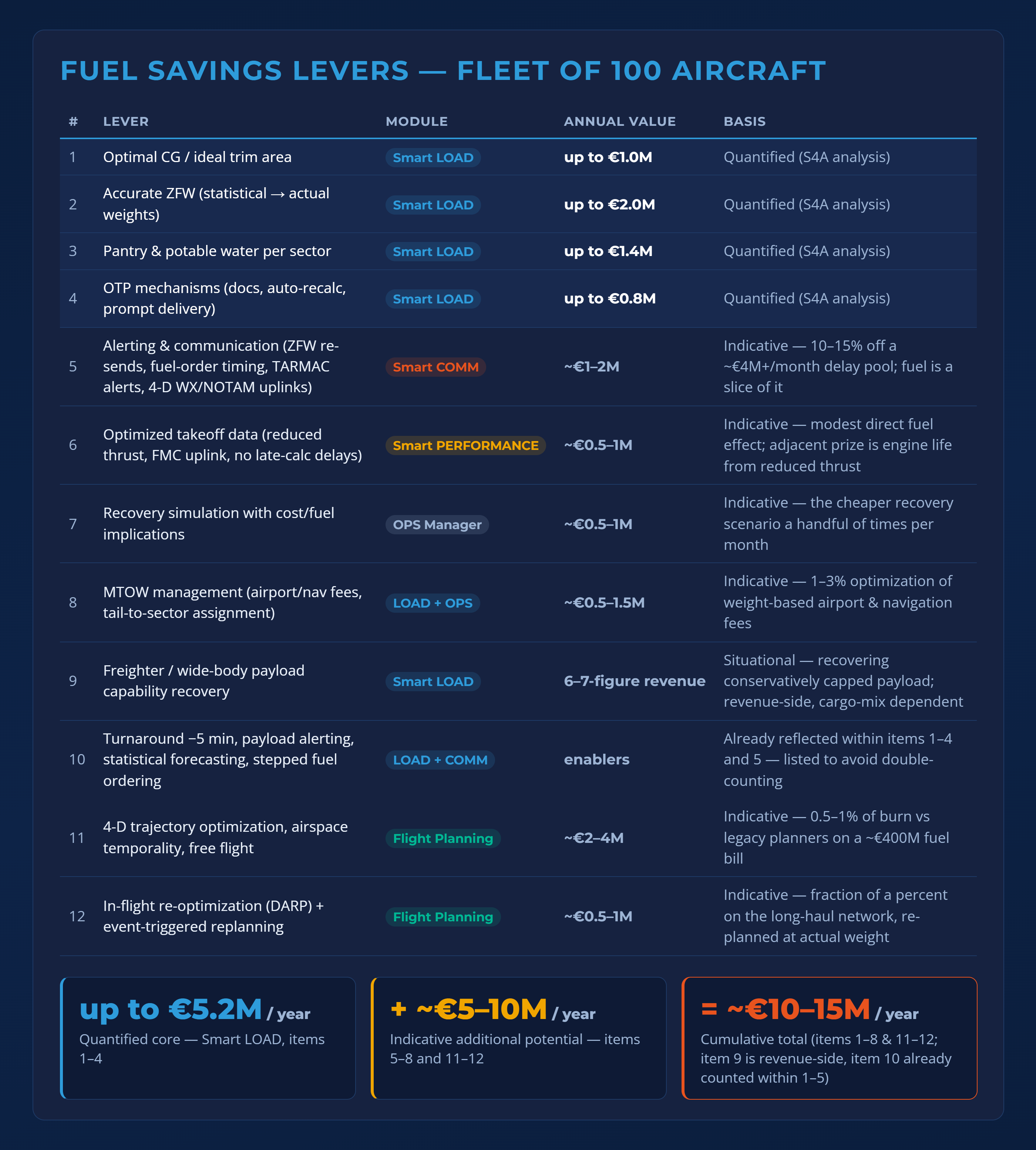
Start where every flight starts: the loading. Weight and balance sits so deep in the routine that most airlines have stopped asking how much fuel it quietly costs them - yet it touches fuel burn through more levers than any other single ground process. Here is the full inventory of where Smart LOAD finds the kilograms: - Optimal centre of gravity, every flight. A forward CG forces the horizontal stabiliser to generate a larger pitch-up moment, reducing net lift and increasing trim drag - an aft CG is materially more efficient. Smart LOAD aligns load distribution to your defined ideal trim area automatically on every departure, displays a fuel vector showing how the CG migrates as fuel burns off, and guards ground stability and tail-tipping limits while doing it - up to €1 million per year for an airline of roughly 100 aircraft, from physics alone.
- Zero fuel weight that is true instead of conservative. An overestimated ZFW means fuel loaded that was never needed — and historical forecasting error compounds into fuel policy, teaching the airline to carry insurance fuel indefinitely against its own uncertainty. Smart LOAD moves each weight component from assumption to fact, at whatever pace your data allows: passengers from adult standard, to male/female, to statistical, to non-standard weights; baggage from standard CAA-approved values, to statistical per IATA AHM 531, to actual weights - with gate bag weight derived from passenger weight; ULD tare from standard IATA values, to averages across your type inventory, to actual weight per serial number. Aligning planned ZFW with actual ZFW is worth up to €2 million per year at 100 aircraft.
- Pantry and potable water as a per-sector decision. Most systems carry full standard galley values and full water tanks regardless of sector length, because they cannot handle anything more precise. Smart LOAD supports pantry from a single code, to multiple codes, to actual pantry weights - and potable water at an accurate percentage from 0–100%, including block-time variables. Treating this carriage as a decision rather than a constant is worth up to €1.4 million per year more.
- Stepped, precise fuel ordering. Initial order at 80–90% issued well before departure, an optional standby step supporting tankering decisions, and a precise final top-up - with the fuel slip generated automatically and delivered to the handler or directly to the fuel supplier. No defensive rounding, no phone-tag with the fuel truck.
- Statistical intelligence on every forecast. Historical cargo and mail weights, baggage ratios, no-show factors, and ramp/trip/taxi fuel data - grouped by airline, flight number, city pair, aircraft type, and day of week - feed forward into every future flight's planning, so estimates converge on reality instead of drifting from it.
- Accurate EZFW upstream to flight planning. The estimated zero fuel weight is calculated and transmitted automatically - and re-sent immediately when it moves past threshold - so the operational flight plan and its fuel calculation are always built on current weight, not the morning's guess.
- Payload carried instead of stranded. Early overweight and low-underload alerting, realistic bulk volume estimation, priority-driven offloading of low-value items, and timely loading of standby shipments mean the aircraft departs full and on time - instead of leaving payload behind in a last-minute scramble that generates delay, and delay generates burn.
- Freighter and wide-body capability recovery. Where legacy systems cannot model what the manufacturer actually permits, W&B engineers impose conservative caps that fly for years. Smart LOAD models flexible CG envelopes based on actual aircraft and fuel weights and engine thrust, normal and increased cumulative load limits, standard and non-standard fuel distributions, cargo and fuel lateral imbalance, and ballast and unusable fuel - recovering capped payload and letting every kilogram of fuel carry revenue.
- On-time performance mechanisms. Digital document transmission instead of printing and walking, automatic recalculation on last-minute changes, prompt W&B delivery to EFB/ACARS for take-off performance, and immediate ZFW re-sends that prevent late re-fuelling - worth up to €800,000 per year at 100 aircraft in avoided delay cost, a meaningful slice of it in kerosene: APU running, taxi queues, holding, and downstream recovery flying.
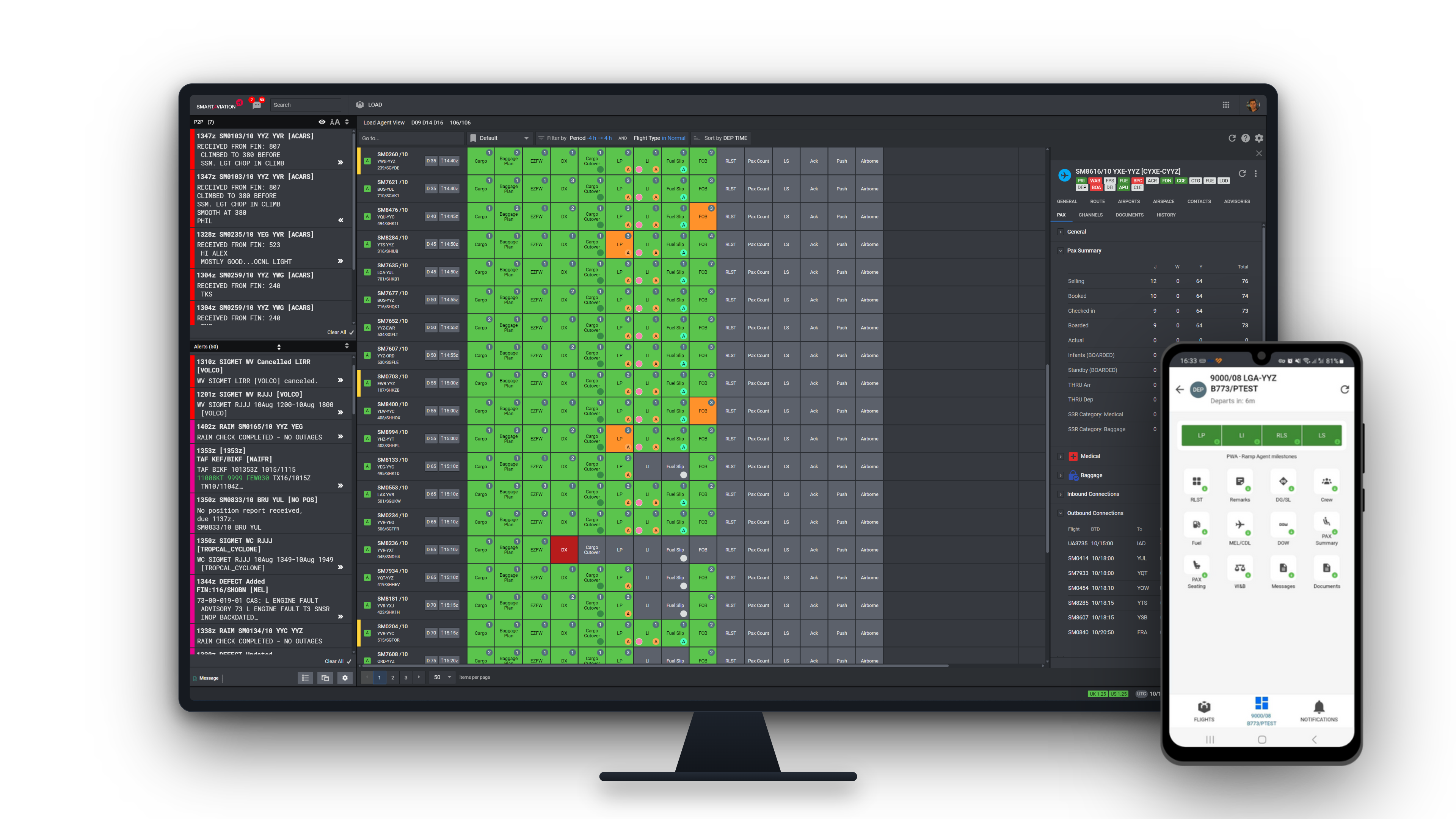
- Improved turnaround times through a combination of pre-emptive management of loading exceptions in conjunction with our mobile load application keeping resources within the footprint of the aircraft.
- Maximum weight management. Airport and navigation fees are assessed on maximum take-off weight, making MTOW a genuine commercial decision. Accurate weight forecasting and exact aircraft weight calculation let you assign aircraft to flights with estimated ZFW and MTOW in view - and operate reduced maximum weights with confidence instead of payload-restriction anxiety.
These figures assume a 100-aircraft fleet and scale proportionally with size. Individually, each lever looks modest; together, on every sector, every day, they are the most dependable fuel savings in the operation - available without a single new aircraft or route.
Smart COMM (Communication & Alerting): information arriving on time is fuel not burned
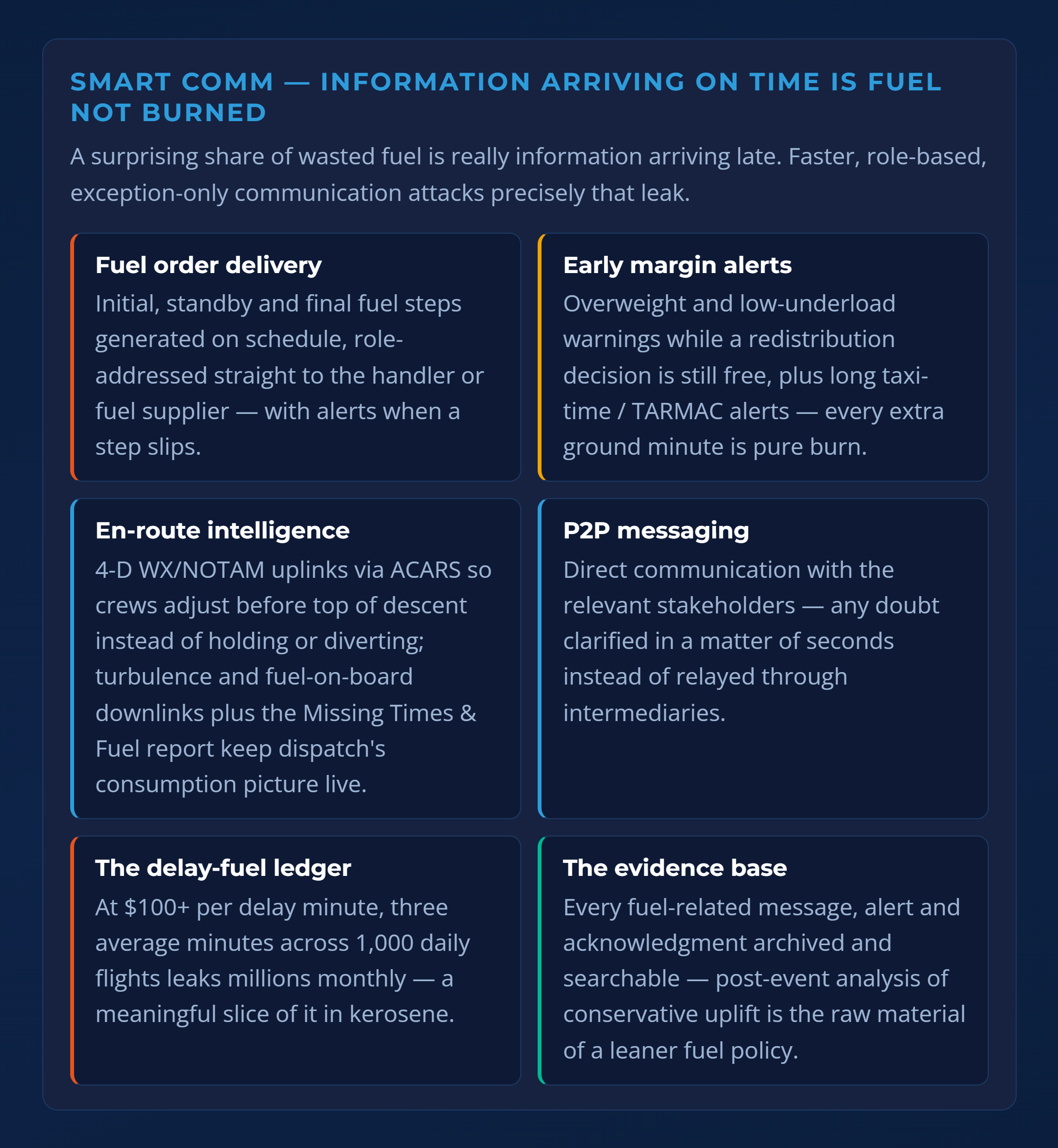
The connective tissue matters more than it appears, because a surprising share of wasted fuel is really information arriving late. Smart COMM's job is precisely that: delivering the proper alerts, on time, to the relevant individuals. Take the zero fuel weight chain - the weight accuracy itself is Smart LOAD's work, but its value depends on the right people learning about changes instantly. When Smart LOAD re-issues a ZFW that has moved past threshold, Smart COMM ensures the alert reaches exactly the roles that must act - the dispatcher whose flight plan needs recalculating, the fueling agent whose order changes, the crew whose figures are affected - the moment it happens, not on the next scheduled transmission or phone call. The same delivery discipline applies to the fuel order itself: initial, standby, and final fuel steps travel as role-addressed messages directly to the handler or fuel supplier, with alerts raised if a step hasn't completed on time - closing the gap between "fuel decision made" and "fuel truck informed" that quietly generates both delays and defensive uplift.
The alerting engine then works the margins across the whole flight. Overweight conditions, low underload, and approaching limitations surface as early warnings to exactly the roles that can act - a re-distribution decision made forty minutes out costs nothing; the same decision made under the aircraft costs payload, delay, and fuel. Long taxi-time alerts flag flights exceeding TARMAC thresholds, where every extra minute of ground running is pure burn. Weather and NOTAM changes reach dispatchers on 4-D route logic and are uplinked to the cockpit automatically via ACARS, so crews adjust early to a deteriorating destination instead of discovering it at top of descent — the difference between an efficient re-plan and holding fuel or a diversion. Turbulence reports, fuel-on-board downlinks, and the Missing Times and Fuel report keep dispatch's picture of actual consumption current across the fleet. And the arithmetic of delay itself belongs in the fuel ledger: with a single delay minute costing upwards of $100 - APU running, taxi queues, missed slots, holding, and the recovery flying that ripples downstream - an airline averaging just three minutes of delay across 1,000 daily flights is leaking millions monthly, a meaningful slice of it in kerosene. Faster, role-based, exception-only communication attacks precisely that leak. Finally, because every fuel-related message, alert, and acknowledgment is archived and searchable, fuel management gains what it usually lacks: an evidence base. Post-event analysis of where uplift decisions went conservative is the raw material of a leaner fuel policy.
Smart PERFORMANCE (Aircraft Performance): the right numbers at the right moment, every takeoff
Takeoff is where weight, weather, runway, and thrust meet - and where accurate, timely computation converts directly into efficiency. Our Smart PERFORMANCE - aircraft performance solution interfaces with the aircraft manufacturers' own computational engines, so every calculation reflects what the airframe actually permits rather than a conservative approximation. Fed with the actual take-off weight and centre of gravity from Smart LOAD - with automatic cross-checks between the two modules - it produces optimized take-off data for the specific tail, runway, intersection, and conditions of the day: the appropriate flap and thrust settings rather than worst-case defaults. Optimized reduced-thrust takeoffs are one of the industry's most established efficiency and engine-life levers, and they are only as good as the weight data feeding them - which is exactly why the LOAD-to-PERFORMANCE data flow matters. MEL and CDL restrictions are applied automatically, so performance is never recalculated by hand from a paper deferral list. Just as importantly, the result arrives on time: computed data is delivered promptly to the EFB or uplinked directly to the aircraft FMC via ACARS - eliminating the late-performance-calculation delay pattern and the manual transcription step it invites. Accurate weights in, manufacturer-exact computation, automatic restriction handling, instant delivery: each takeoff flown on its true optimum instead of a padded estimate, sector after sector.
Flight planning: every track mile has a price tag
If loading decides how efficiently the aircraft flies, flight planning decides how far it must fly - and this is where today's political geography bites hardest. Legacy route optimizers, many conceived decades ago, discard candidate routes early and struggle with dynamically constrained airspace. The next-generation flight planning solution used by Qantas takes the opposite approach: it assesses all possible paths, models performance for the specific tail, and applies fuel and navigation constraints up front. Its 4-D trajectory optimization interacts with airspace temporality - speeding up or slowing down a 14-hour flight to transit special-use airspace when it's inactive rather than flying around it, saving track miles and fuel that a 3-D planner simply cannot see. Free-flight capability rides favorable winds across oceanic expanses; automated event triggers regenerate the plan whenever ZFW, departure time, weather, or fuel requirements change, so the aircraft always departs on the freshest optimum rather than a stale one. And with automated in-flight re-optimization (DARP), long-haul flights are re-planned at top of climb on actual weight and time - recovering efficiency that evaporates between briefing and takeoff. In a world where closed airspace reshuffles routes weekly, an optimizer that finds the best compliant trajectory every time is a fuel policy in itself.
Across the suite, the same logic
The pattern repeats in every domain. Fleet and schedule management assigning aircraft to flights with weights and capabilities in view, so the right tail flies the right sector. Recovery simulation that shows the fuel and cost implications of each disruption scenario before you commit to one. Flight tracking with turbulence and deviation awareness supporting efficient flight watch. Briefing packages whose accuracy keeps crews planning on current reality. Each module contributes its kilograms; the connected platform makes them compound.
A pragmatic closing: the features are there - the discipline is yours
Let's be straightforward, because credibility matters more than a marketing. These savings are not delivered by only installing software; they are delivered by integration, data quality, and operational discipline. An airline that connects the systems properly to flight planning, check-in, cargo, and fuel sources - that moves honestly from standard to statistical to actual weights, that defines its ideal trim area explicitly with its W&B engineers - realizes the numbers above. An airline that treats the tools as screen replacements gets better screens and a fraction of the benefit. The capability is in the product; the realization is in the implementation.
But here is why the conversation is worth having now: with fuel prices where geopolitics has pushed them, the business case has never been larger. The figures above scale with fleet size - and for many operations, the combined savings across CG optimization, ZFW accuracy, carriage optimization, and delay reduction mean that implementing a new Smart4Aviation system can pay back its investment within the first few months of use. Fuel prices are set by the world. Fuel consumption is set by your operation. Let's talk about which one you'd rather depend on.
A note on scope: fuel is only one chapter
Finally, to be clear about what this article deliberately did - and did not - cover: we focused exclusively on features and mechanisms related to fuel savings, because the current price environment makes that business case the most urgent. But fuel is only one chapter of the full story. The same platform delivers a range of equally important benefits that were not the purpose of this article and that further reduce operational costs: end-to-end automation of routine processes, exception-based operations that let one professional safely supervise what once occupied a team, the corresponding FTE efficiency and productivity gains, reduced training and support costs from a single consistent platform, infrastructure and licensing consolidation, fewer errors and their downstream costs, improved on-time performance beyond its fuel component, and stronger compliance through comprehensive audit trails. Each of these deserves — and has — its own analysis. Taken together with the fuel savings described here, they are the reason the total business case for a consolidated Smart4Aviation implementation is consistently stronger than any single dimension suggests. If you'd like the complete picture for your operation's size and profile, that's exactly the conversation we'd welcome.