Welcome to Smart4Aviations Smart COMM
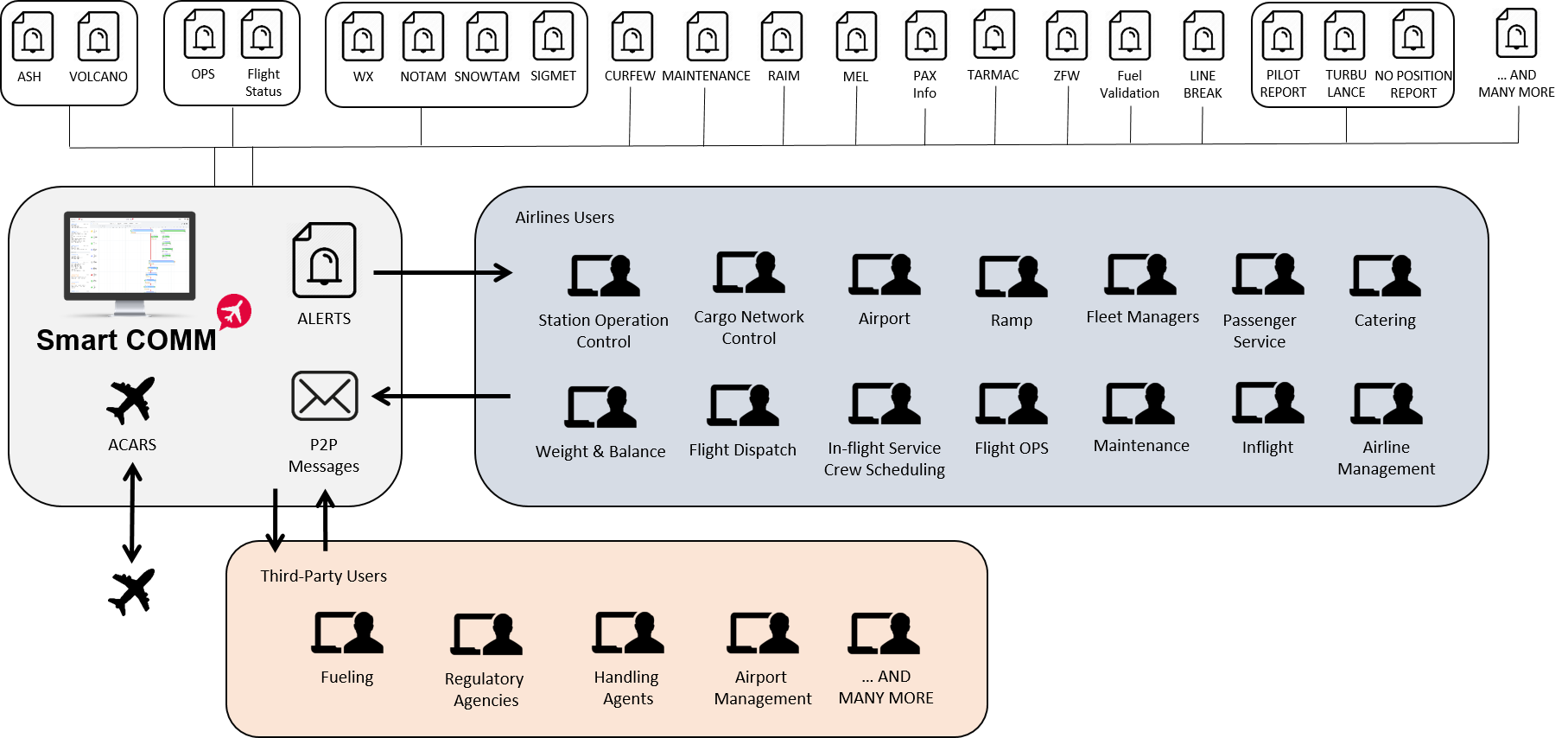
Imagine having the ability to manage your Airline from a communication platform that can eliminate the need for any emails, phone, fax, or voice dialog. Imagine what you could do if you could connect your many systems (in-house and third-party) to one dynamic software module. A solution that understands operational challenges and changes, and will automatically alert and communicate this information only to the responsible (need to know) audience.
Smart COMM was initially proposed as a simple replacement for an antiquated message que, but it was soon realized that this was an opportunity to create a tool that could transform the industry. The vision became to develop a seamless communication platform capable of understanding the complex realities of everyday Airline operations. A system designed for collaboration, sharing, and the archiving of information between internal business units and third-party stakeholders providing a single source of information necessary for an Airlines to succeed in todays and tomorrows every changing business environment.
Why choose Smart COMM?
- Is your business presently dependent on manual communications and alerting of critical information (Mobile Radio, Email, Telephone, Voice Communications, etc.)?
- Does your in-house communication and alerting capabilities provide automatic targeted communications to the need to know players (role-based communication) to promote situational awareness of broad network initiatives for leadership oversight during all and or irregular operations?
- Does your in-house communication and alerting capabilities remove organizational communication barriers, and does your communication ensures that all relevant players receive the same message?
- Can you automatically identify and filter an inbound message content based on predefined rules and keywords to provide automatic Alerts to all users based on their roles? Alerts can be for Any activity such as NOTAMs, WXX, Delays, Diversions TARMAC, EZFW changes, Aircraft Swaps, line maintenance, fueling, late boarding. Departure control Etc.
- Does your alerting and communications capabilities provide an automatic escalation chain to ensure compliance and provide acknowledgment receipt?
- Do you currently have the capabilities to archive your corporate messages and communications automatically? If you do, are these historical communications searchable for future review and analysis?
- Do you have communication and alerting capabilities that improve communication in different languages through standard universal messaging?
- Does your in-house communication and alerting capabilities support multiple communication tools such as email, jabber, slack, spreadsheets/reports, etc.?
- Do you have a process in place that automatically forwards critical communications and alerts to those that need to know both internally and externally (Third-Part Vendors)?
- Do you have the capabilities to deliver critical on-route NOTAM, WXX, etc. automatically to the cockpit?
- Does your current communications capabilities allow you to communicate bi-directionally with your flight deck and cabin crews?
The above are just a few of the common challenges that confront many Airlines on a daily basis.
The Solution
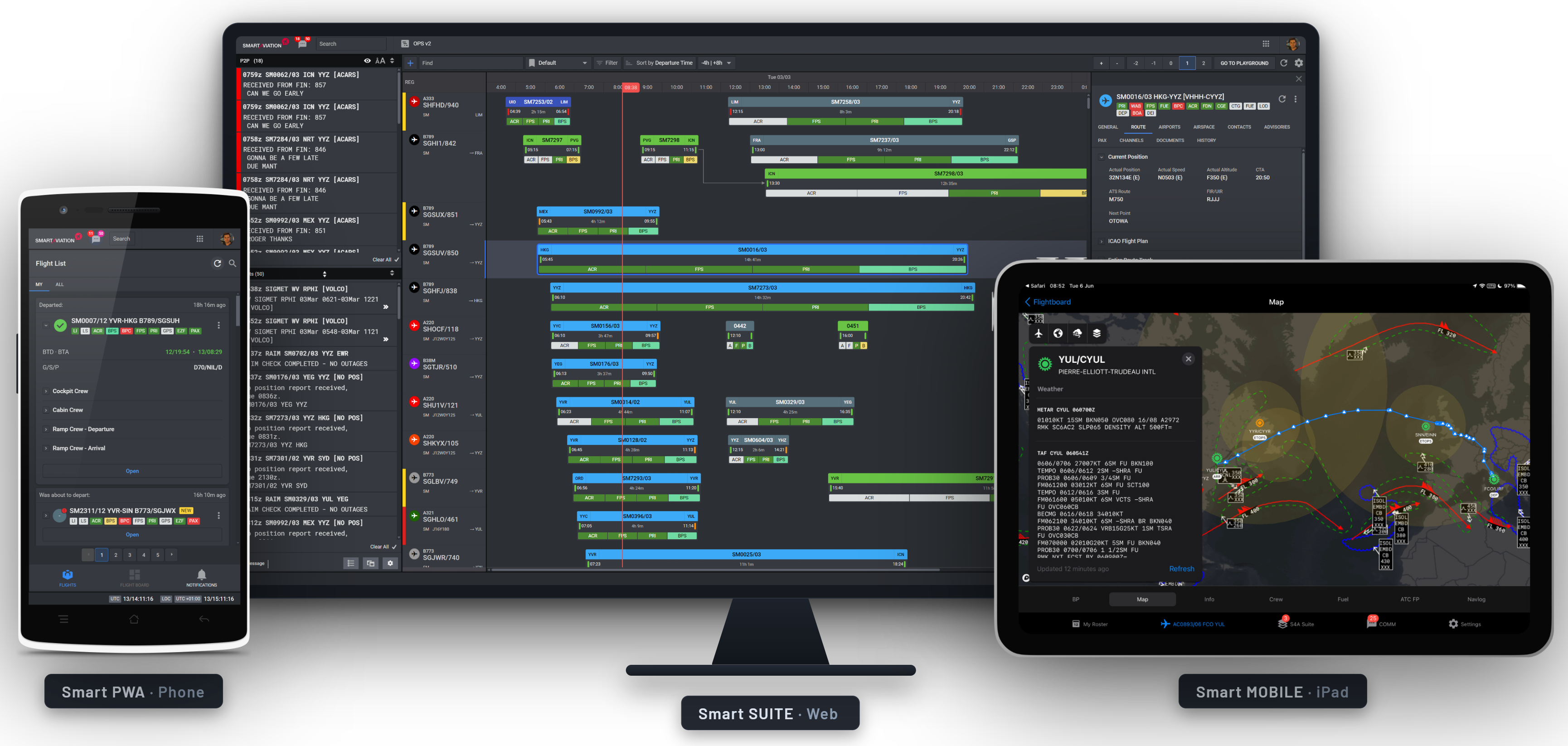
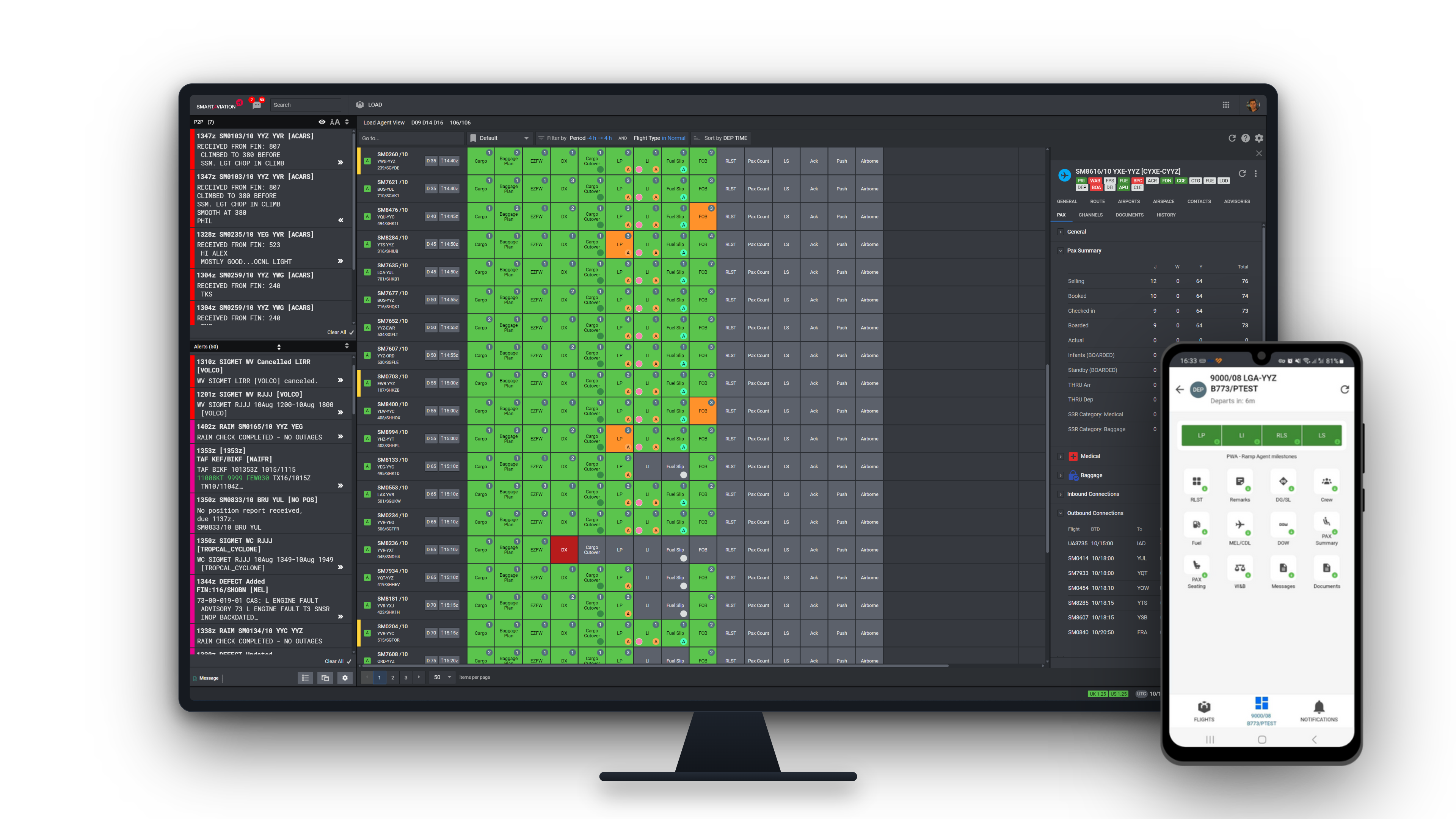
Smart COMM is a unique and simple to use Web and Mobile based communication solution which will be fully integrated with all your current airlines’ operational system(s).
Immediate automatic communication and alerting ensure efficient operations. Operations Control, Flight Dispatch, Weight and Balance, Fuelling, Maintenance, Flight Operations, Inflight, Aircraft Routing, Crew Scheduling, Station Operations, Ramp, Pax Services, Catering, De-Icing, etc. can now collaborate on operational problems and situations using a common platform. Smart COMM can also be deployed to any of your third-party agencies to further support your operational integrity.
All users have a common view of the Airline's operation, but as each defined role is specific Smart COMM can be configured to share information only relevant to each user’s role including multiple dynamic screen configurations to display tasks and information relevant to the role. Critical information is automatically alerted in real-time as changes occur. The communication between ground staff and aircraft via ACARS is available with a single mouse click. Smart COMM treats each aircraft as just another user of the system, handling all complex ACARS coded message formatting, behind the scenes. Furthermore, the System can respond to ACARS transaction requests issued by aircraft, as well as automatically alerting pilots of any relevant operational information, ensuring regulatory compliance for flight watch.
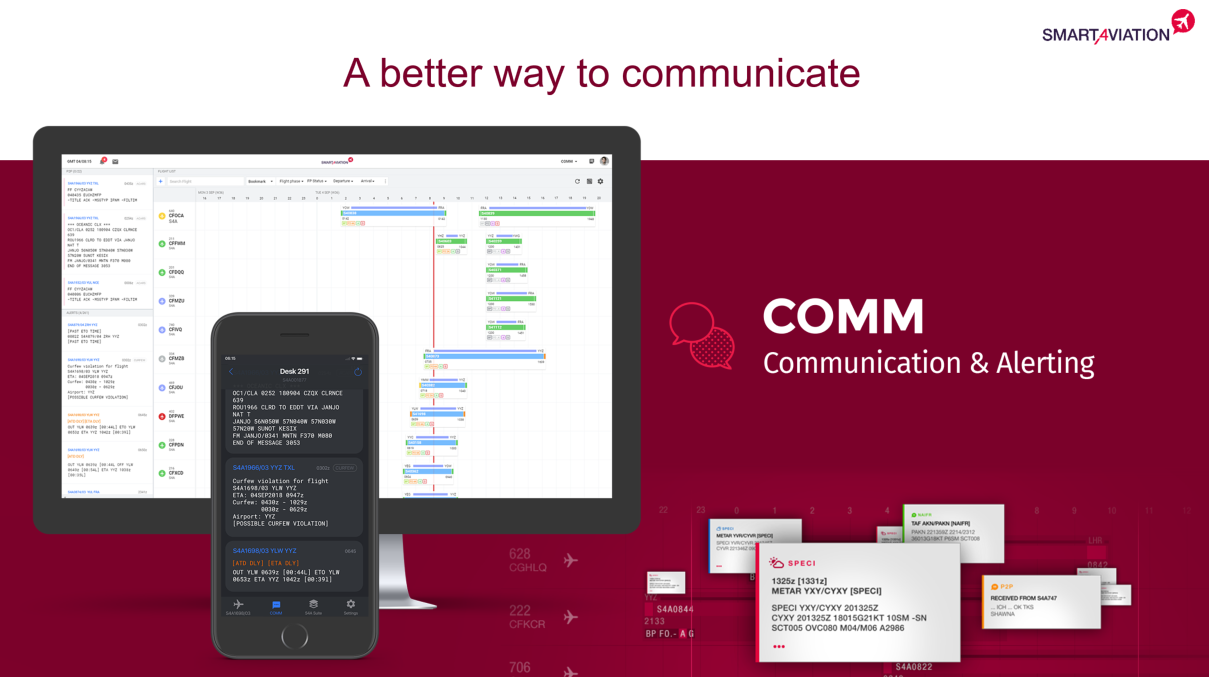
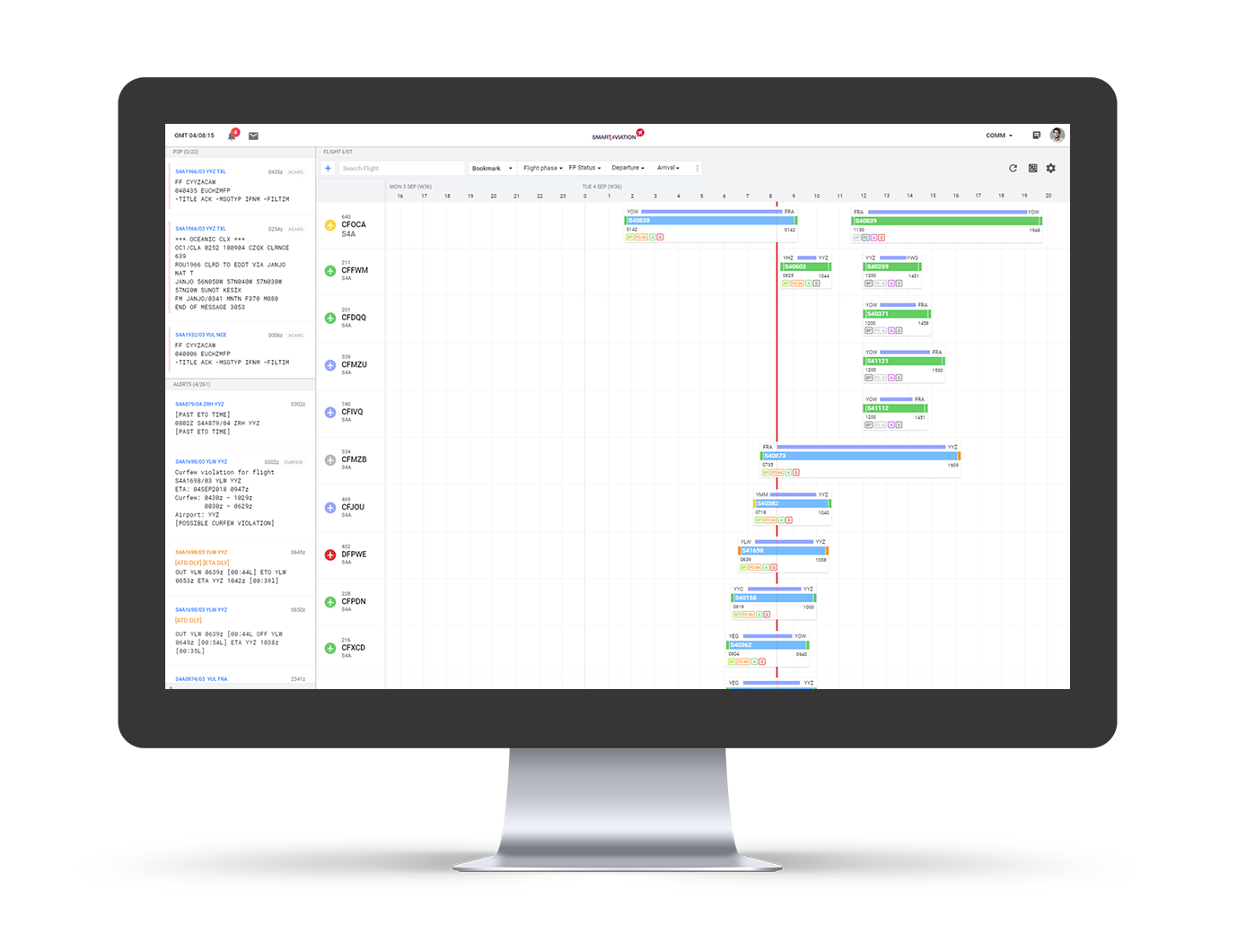
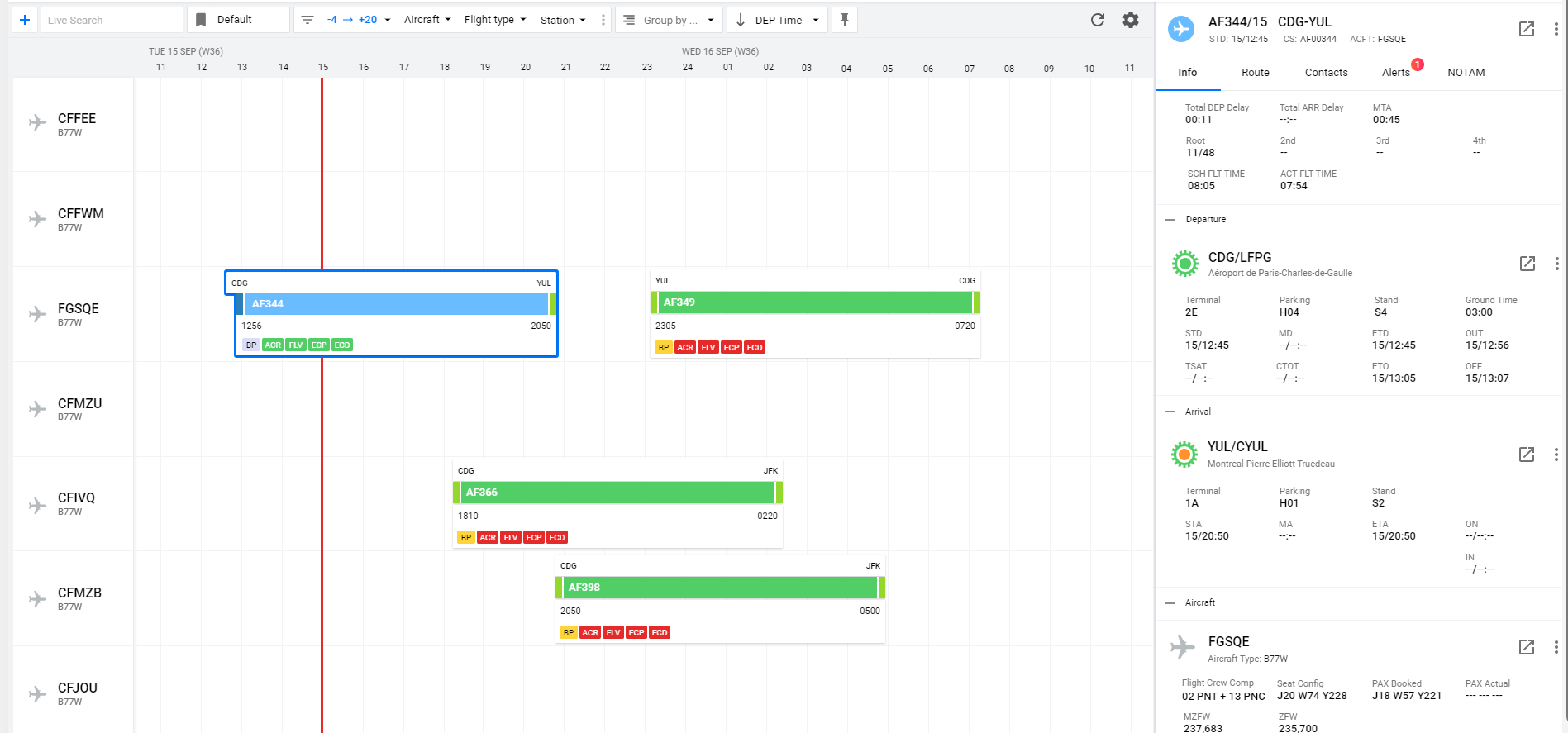
A full-featured Gantt chart provides a complete “day of” schedule and fleet management solution displaying: real-time flight, aircraft, and schedule operations information (flight status, operational times, briefing package, MELs, messages, alerts, etc.) through an interactive user interface. All operations relevant flight details are available with just one click.
Alerting
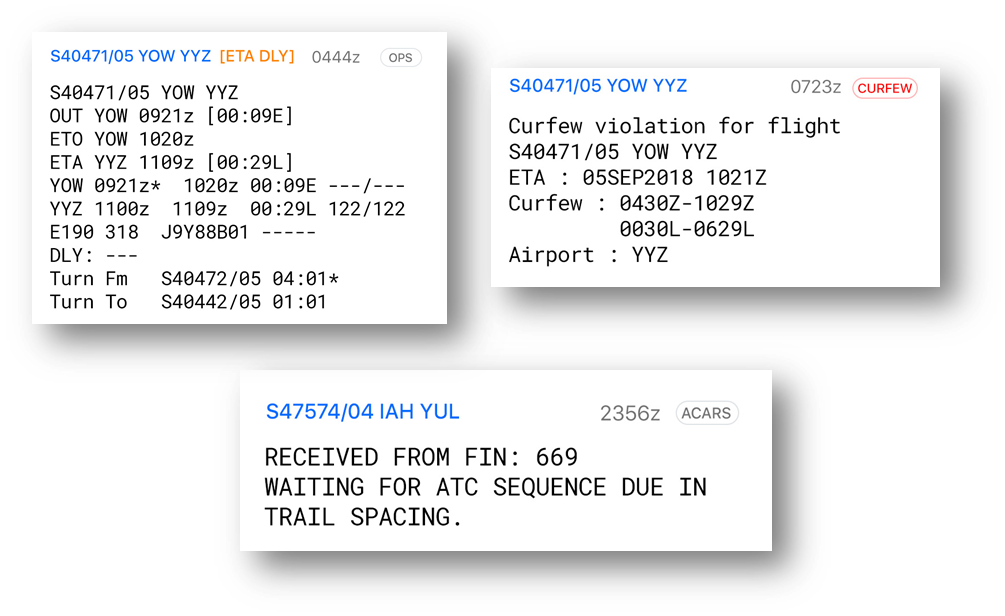
One of the unique features of Smart COMM is our automatic Alerting functionality. Hundreds types of alerts have been created to warn of any operational conditions, providing users with a comprehensive view of the operation in real-time.
Smart COMM understands confusing airline acronyms and translates them to plain language Airline can precisely customize the types of alert and conditions for each user group to ensure no user is bothered by irrelevant information regardless of an individual’s role. Key examples of events for ground, Airports, and station personnel are flight cancellations, aircraft changes, and delays; for operational personnel such as Flight dispatchers and controllers, alerts such as NOTAMs, Weather, en-route turbulence and altitude variance can be configured. Pilots can be automatically informed via ACARS about changing weather, aerodrome conditions, or ATC restrictions. Smart COMM’s powerful and intuitive assignment builder and the administrative tool were designed for the simple management and maintenance of the systems functions, access rights, and alert routing capabilities. Smart COMM is fully configurable by you allowing your Airline to operate the way you want it.
Smart COMM Mobile
Our Smart COMM Mobile capabilities allow users to effectively manage your operation remotely from a mobile device and as inflight connectivity advances Smart COMM will be just as powerful in the Air as it is on the ground essentially eliminating the need for back up operational facilities.
On-Time Performance
Next to Safety On-time performance is a critical indicator of every airline’s success. These indicators directly affect your customers, however, many airlines continue to struggle to improve their OTP or maintain it to a higher level. No doubt, there are many factors influencing the OTP, and not all of them are under your airline’s control.
As operational costs continue to escalate the addition of Smart COMM will assist in dramatically reducing your operational response time realized in improved OTP and schedule integrity. Smart COMM will provide a positive return on your airline bottom line.
The FAA / Nextor estimated the annual costs of delays (the direct cost to airlines and passengers, lost demand, and indirect costs) in 2018 to be $28 billion globally. Data analysis carried out by the Airline of America in 2019 estimates that each minute an aircraft has delayed the cost to a carrier is approximately $74.20 USD (Fuel -$25.26, Crew – $24.55, Maintenance - $12.01, Aircraft Ownership - $9.58 & Other - $2.80).
The financial impact of a delay on your airline can easily be calculated by taking the number of flight delay minutes for one calendar month and multiply that number by $74.20 and if you were able to reduce each of those delays by 1 minute you would have saved the amount of your calculated.
It was also determined that flights that were subject to ATC issues and operationally controllable delays that could have been mitigated or optimized much sooner if the airlines had more advanced, real-time notification and alerting, which can be provided by our Smart COMM solution.
Smart COMM will have a direct impact on Customers, Employees, and most importantly your airline’s operational safety.
Benefits of using Smart COMM
Smart4Aviation’s Smart COMM will assist in supporting:
Safety of Flight, Reduced Risk
| Immediate and automatic alerting of hazards and events affecting the safety of flight
|
Reduction in Operational Costs
| Immediate visibility to all flight operational & disruption information (Alerting)
Improved and rapid recovery from irregular operations
|
Improved Operations Performance and On-Time Performance
| Reducing delay costs
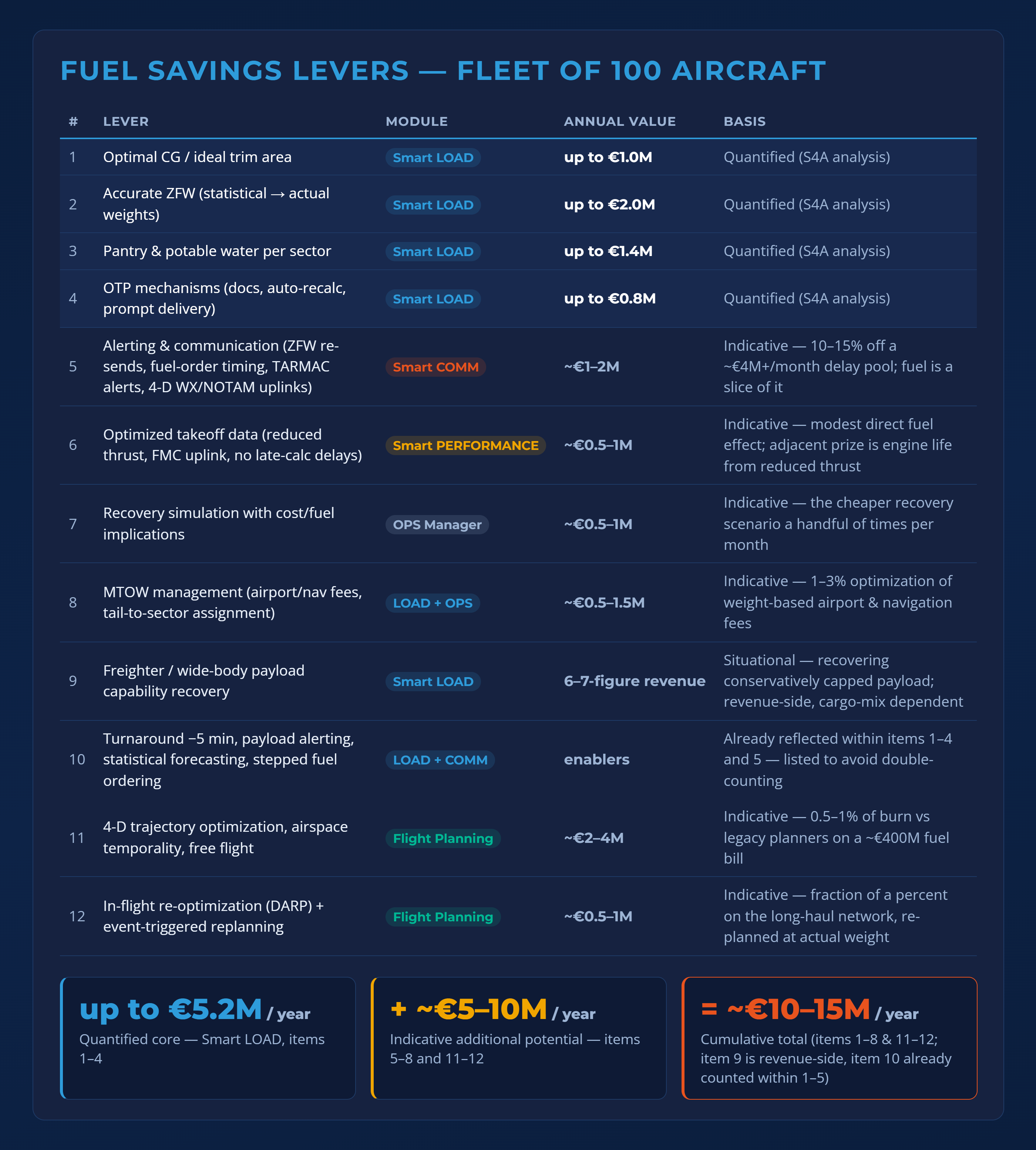
Reducing fuel consumption
|
Increase in Organization Communications
| The right information is immediately delivered to the right people at the right time.
Shorter response and reactions times in crisis situations
Improved collaboration on operational problems
Information available allowing for pro-active decision making
|
Improved flight watch
| Alerting for enroute conditions such as turbulence and altitude variance
Configurable alerting for the operational conditionals of choice.
|
Key Features of Smart COMM
- Real-time on-screen messaging and alerting
- Flight following and monitoring - displaying flights, rotations, maintenance events, and other relevant information on a dynamic Gantt display
- Peer to Peer communication and enhanced messaging functionality with pre-defined templates
- Chat/conversation functionality dedicated to a specific alert allowing all stakeholder to be in the loop
- Two-way ACARS messaging with automatic ACARS uplink and downlink transactions
- Rule-based alerting (weather, NOTAM, ACARS, load, fuel, operational events, Curfew, PAX, MELs, and much more)
- WX/NOTAM change alerts sent via ACARS
- High precision NOTAM/Weather alerting due to 4 dimension flight route based information
- The precise configuration of who receives which alerts and when
- Alerts grouping by pre-defined alerting groups displayed in the summary view
- Ability to send alerts to external systems via alert queues maintained by the client
- Fuzzy logic message addressing
- Real-time flight monitoring of turbulence, winds, and altitude variance
- Customizable alerting rules and workloads
- Archiving of all important communication events and operational messages
- The detailed history of events
- The extendable platform for all airline-specific information alerting
- ACARS initialization
- Maintenance events monitoring
- The built-in eSTOC module allows maintenance planners to assign, manage and track tasks for other maintenance groups
- RAIM check functionality
- Generic milestones interface allowing the airline to feed COMM with information about the progress of the flight preparation process and display it on the Gantt diagram and alert if thresholds have been exceeded
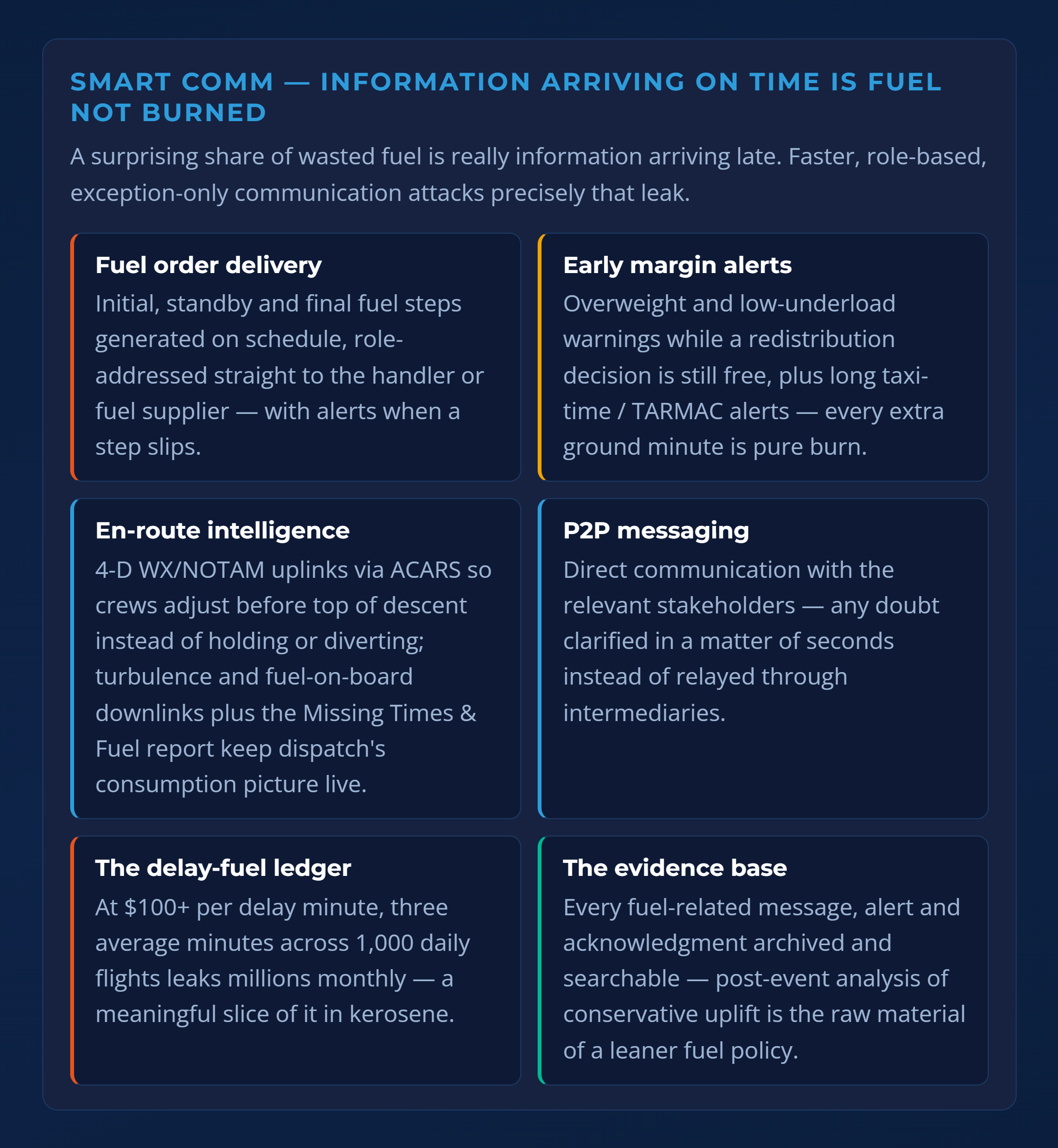
- Fuel monitoring
- Tight integration with other Smart4Aviation products
- Mobile extension available for your tablets offering the same messaging and alerting capabilities – Smart COMM Mobile
Smart4Aviation is considered by many Global Airlines as the leading provider of the most advanced communication, alerting and operational solution available. The backbone of our products is our dedicated team of subject matter experts and information technology professionals committed to developing and deploying the best possible operational tools that make sense and offer your business a positive return on your investment. Our development is driven by a collaborative strategy of working closely with our customers, industry experts and our own visionary leadership. Smart4Aviation is the solution provider of choice for an impressive portfolio of satisfied customers and we are committed to doing it “the right way” and our customer service is exceptional! It’s time for you to make the Smart choice and see how Smart4Aviation’s Smart COMM will change your future!